Moving to Montverde, Florida? What to Know About Hurricanes, Flood Zones & Elevation
If you're considering moving to Florida but hurricanes and flooding make you nervous, Montverde deserves a closer look.
Located inland in Central Florida, Montverde is known for something many people relocating to the state don't expect: hills.
The rolling terrain, elevated homesites, lakes, larger properties, and luxury communities like Bella Collina create a landscape that feels very different from the flat, coastal Florida many buyers picture.
Does that mean Montverde is hurricane-proof or that every home is free from flood risk? No—and I would never tell a buyer that.
But it does mean the conversation is very different from buying directly along Florida's coastline.
In Montverde, we're not evaluating beachfront storm surge. We're looking at wind, rainfall, drainage, elevation, proximity to lakes, and the FEMA flood designation of the individual property.
And that's an important distinction for buyers who love Florida but aren't sure they want coastal exposure.
Here’s what I would want you to know before buying a home in Montverde or Bella Collina.
Florida Gets Hurricanes. But Where You Live in Florida Matters.
Let's start with the obvious: Florida gets hurricanes.
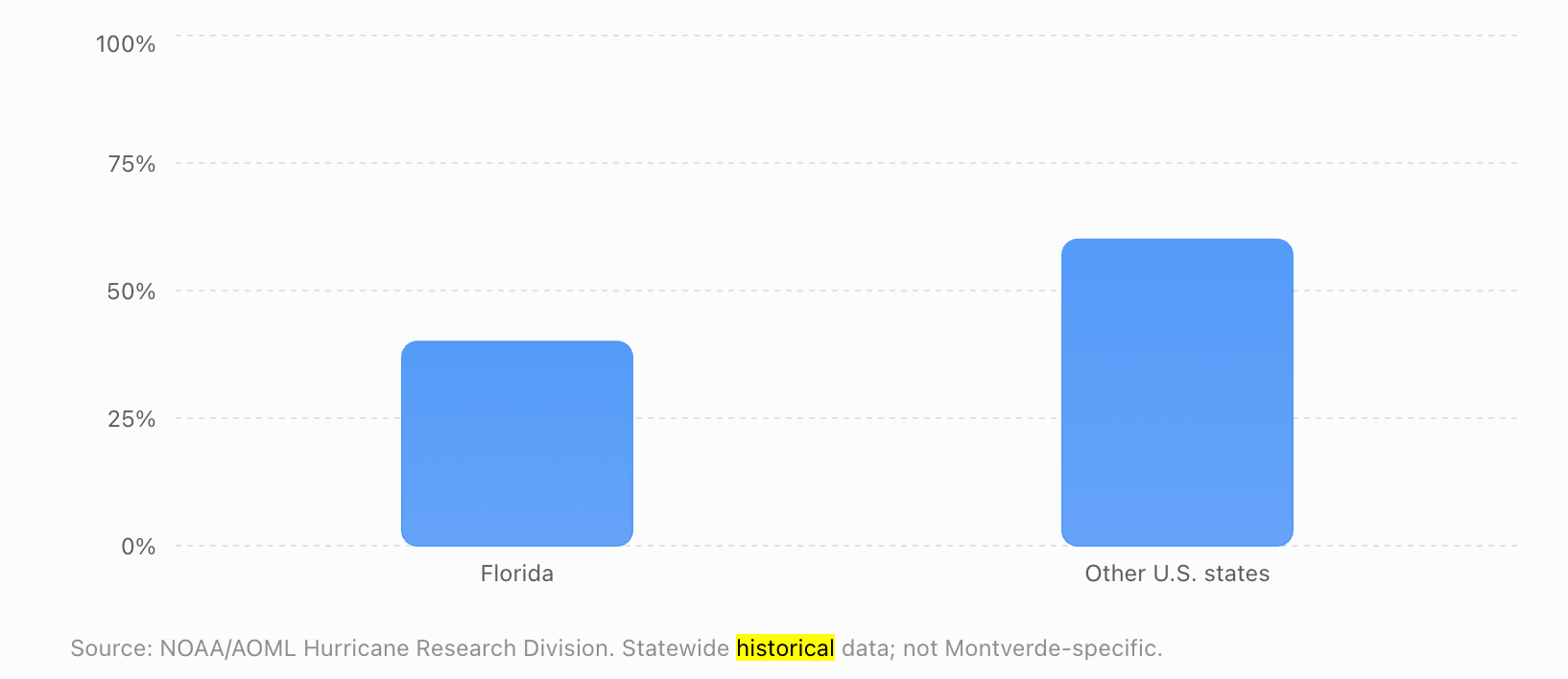
According to NOAA's historical hurricane data, 40% of all U.S. hurricanes have hit Florida. (NOAA AOML)
That statistic can sound intimidating when you're considering a move from another state.
But it doesn't tell the whole story.
Florida is a large state, and there is a major difference between owning a home directly along the coastline and owning one inland in Central Florida.
Florida's Share of Historical U.S. Hurricane Hits
Source: NOAA/AOML Hurricane Research Division
Montverde sits inland in Lake County, west of Orlando. That means the coastal storm surge associated with beachfront communities isn't the same issue we're evaluating when looking at a home in Montverde.
Hurricanes and tropical storms can still travel across Central Florida and bring strong winds, heavy rain, tornadoes, downed trees, power outages, and localized flooding. In fact, Lake County specifically advises residents that hurricanes, tropical storms and heavy rainfall can create flood threats in low-lying portions of the county. (Lake County FL CDN)
So I don't tell my clients:
“You don't have to worry about hurricanes here.”
Instead, I tell them:
Let's understand the type of risk we're actually buying.
For many buyers who want the Florida lifestyle without living directly on the coast, that distinction is worth understanding.
One of Montverde's Biggest Surprises: The Hills
This is one of my favorite parts about showing Montverde to someone who's never been here.
Most people arrive in Florida expecting flat land.
Then we drive into Montverde.
Suddenly, we're driving up and down hills, looking across lakes, seeing homes perched above the road and touring properties with views that don't feel like what many buyers imagined Central Florida would look like.
That terrain is part of what makes Montverde—and especially Bella Collina—so unique.
But elevation isn't something I use as a blanket guarantee against flooding.
Even within an area with rolling terrain, one property can sit significantly higher than another. A lakefront home, a homesite on a slope, and a property sitting near a natural drainage area can all have completely different considerations.
That's why flood risk needs to be evaluated at the property level.
Does Montverde, Florida Flood?
Yes, flooding is possible in Montverde, just as it is throughout Florida and much of the United States.
But saying “Montverde floods” isn't particularly useful.
The better question is:
Does the specific property I'm considering have meaningful flood risk?
According to FEMA's explanation of flood zones and flood maps, flood zones represent different levels of flood hazard, and factors such as elevation, proximity to water and different types of flooding can affect risk. (FloodSmart)
That means two properties located relatively close to each other can have very different considerations.
For buyers, that's why I don't eliminate an entire town based on a generalized flood map.
I look at the actual property.
Understanding Flood Zone X
If you're shopping for homes in Central Florida, you'll probably hear the term “Flood Zone X.”
You'll also hear people casually describe Zone X as “not in a flood zone.”
Technically, I don't love that phrase.
Every property has some level of flood risk.
FEMA currently identifies B and X areas as moderate risk and C and X areas as lower risk, depending on the specific map designation. (FloodSmart)
So seeing Zone X can certainly be reassuring compared with a high-risk designation, but it does not mean flooding is impossible.
I still want to understand the property itself—especially if we're looking at acreage, lakefront property, unusual grading, or a custom homesite.
What About Flood Zone A?
This deserves more attention.
FEMA identifies A-designated areas as high-risk flood areas. (FloodSmart)
If I'm showing a buyer a Montverde property that includes Zone A, that doesn't automatically mean:
Don't buy it.
It means:
We need more information.
For example, a larger property could potentially contain land with different flood considerations than the location of the actual house.
That's why we investigate the individual property rather than making assumptions from the city name or ZIP code.
Depending on the property, I may want my buyer to investigate the location of the structure, flood-zone boundaries, elevation, drainage and grading, available elevation certificates, previous water intrusion or flooding information, insurance options and any lender requirements.
It's information—not necessarily a deal breaker.
Here's the Flood Statistic I Want Every Buyer to See
This is one of the most important statistics in this entire article.
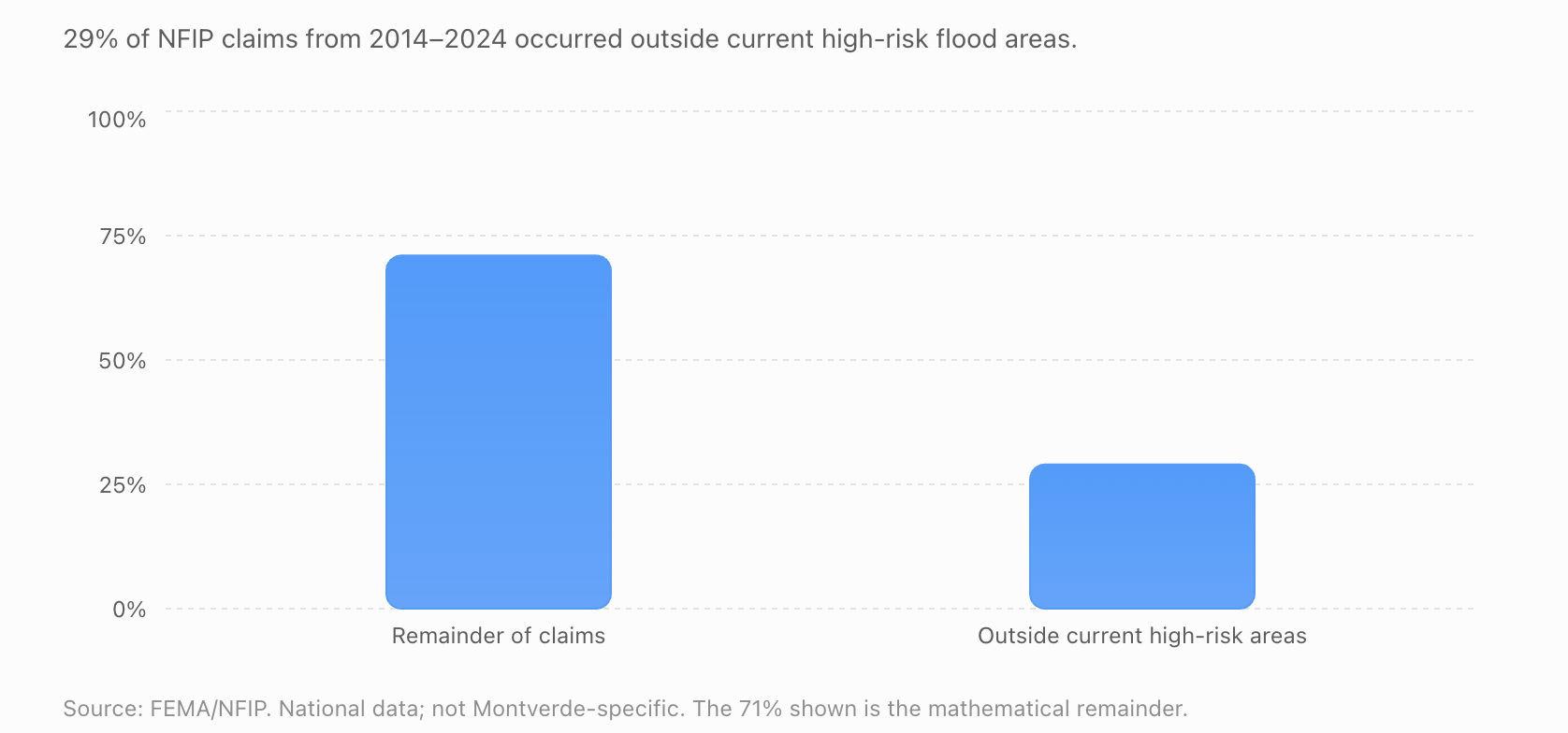
According to FEMA, 29% of National Flood Insurance Program claims from 2014 through 2024 came from areas outside current high-risk flood areas. (FloodSmart)
Flood Claims Don't Only Happen in High-Risk Areas
Source: FEMA National Flood Insurance Program
Why does that matter?
Because it reinforces something I tell buyers all the time:
Don't stop your due diligence because you see “Zone X.”
A flood map is one piece of the property analysis—not the entire analysis.
The goal isn't finding a magical location where weather doesn't exist.
The goal is understanding your property before you buy it.
Why Hurricane-Conscious Buyers May Want to Look Inland
If hurricane exposure is one of your biggest concerns about moving to Florida, it's worth understanding the difference between coastal and inland living.
FEMA explains that storm surge is the unusual rise in seawater associated with hurricanes and other coastal storms. (FloodSmart)
Montverde isn't a beachfront community.
So while a tropical system can absolutely bring wind, rainfall, tornadoes, falling trees, outages and localized flooding into Central Florida, direct coastal storm surge isn't the same exposure we're evaluating in Montverde.
That's one reason some hurricane-conscious relocation buyers may decide to explore inland communities.
They still get access to Central Florida and the Orlando lifestyle, but they're evaluating a different property environment than they would directly along the coast.
And then they discover the hills, lakes, larger homesites and communities here—and Montverde starts making a lot more sense.
What About Bella Collina?
This is where the conversation gets especially interesting.
Bella Collina is one of the most visually distinctive luxury communities in Central Florida.
The elevation changes are part of what makes it so memorable.
You have rolling hills, lake views, homesites at different elevations, custom estates, and properties that can feel completely different from one street to another.
For buyers concerned about flooding, it's easy to drive through Bella Collina, see a home sitting high above the surrounding landscape and assume there's nothing else to investigate.
I still don't do that.
We check the specific property.
That's particularly important when purchasing a vacant homesite.
Before getting emotionally attached to a view, buyers need to understand the land itself.
Depending on the property, that can include flood zones, wetlands, drainage, grading, elevation, utilities, building setbacks, and where the future home can actually be positioned.
One homesite may have completely different considerations from another homesite a few streets away.
That property-by-property analysis is especially important when you're making a significant investment in land and then building a custom home.
Flood Risk Isn't Just a Florida Problem
This is another statistic that surprises relocating buyers.
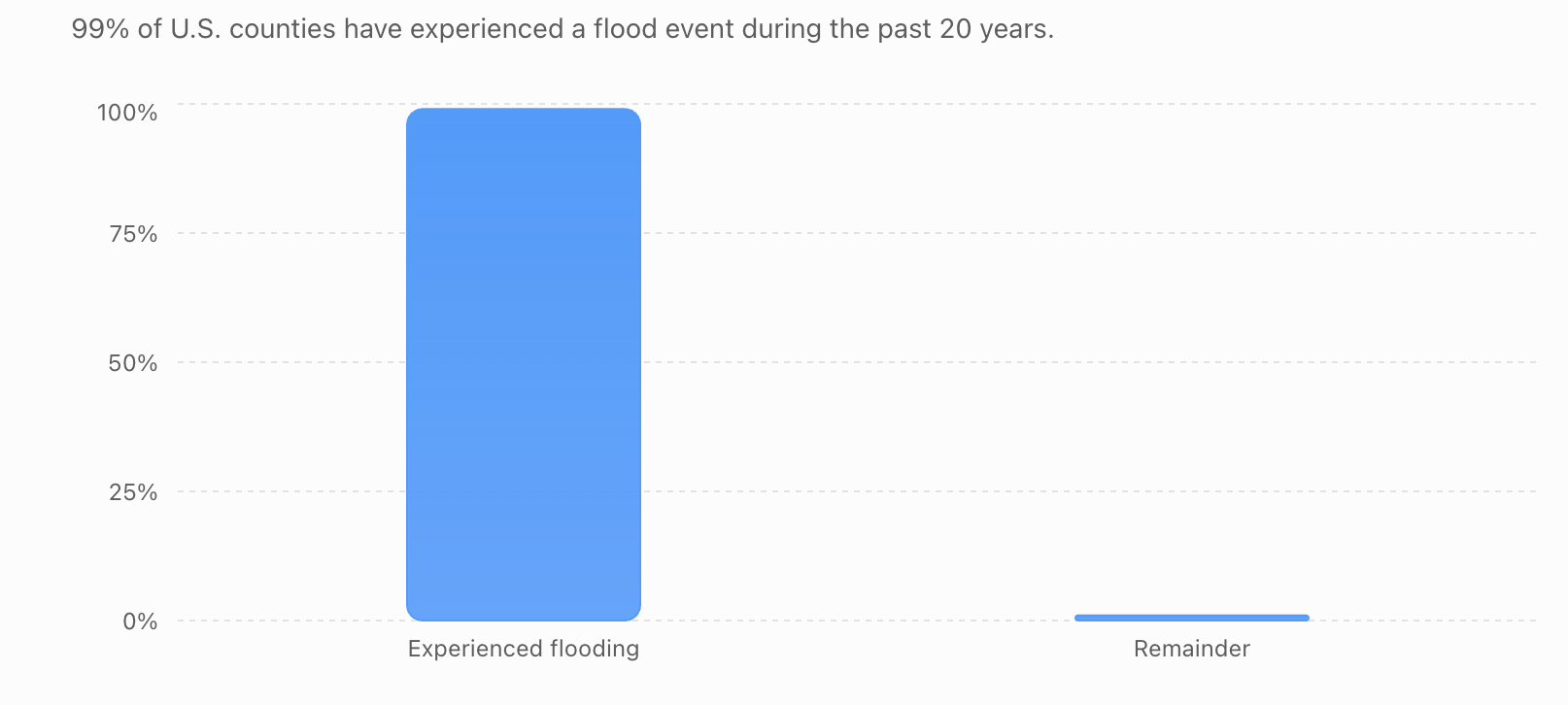
According to FEMA, 99% of U.S. counties have experienced a flood event during the past 20 years. (FloodSmart)
Flooding Is a Nationwide Issue
Source: FEMA FloodSmart
That's important perspective for someone relocating.
People naturally associate Florida with hurricanes and flooding, but flood exposure isn't exclusive to Florida—or even to coastal states.
That's why I prefer education over fear.
You don't need to panic because you're buying in Florida.
You need to know what you're buying.
Does Homeowners Insurance Cover Flooding?
This is something I want every Florida buyer to know before closing.
According to FEMA, most homeowners insurance does not cover flood damage. (FloodSmart)
Flood insurance is separate coverage.
And even if your lender doesn't require flood insurance, you can still discuss voluntary coverage with a qualified insurance professional.
Whether it makes sense will depend on your individual property, risk tolerance, available coverage and cost.
I recommend getting insurance information early in the buying process, rather than waiting until the last few days before closing.
Insurance is part of the cost of owning a home in Florida, so I want my buyers understanding those numbers before they're completely committed to a property.
What I Look at When Helping a Buyer in Montverde
When I'm helping someone purchase a home or homesite in Montverde or Bella Collina, I'm looking beyond the listing photos.
Depending on the property, I want to understand:
The FEMA flood designation — Is the property in Zone X, Zone A or another designation?
Where the actual structure sits — Especially when we're dealing with larger parcels.
Elevation and topography — How does the home or proposed building site sit relative to the surrounding property?
Drainage — Where does water naturally move during periods of heavy rainfall?
Proximity to water — Is it lakefront or adjacent to a lower-lying area?
Property history — Is there information regarding previous flooding or water intrusion?
Insurance — What coverage is available, what might be required, and what will it cost?
Vacant land considerations — If we're buying a homesite, are there floodplain, wetland, drainage, grading, setback or other considerations that need further investigation?
Lake County also provides buyers and property owners with local floodplain information and FEMA flood-map resources. (Lake County FL CDN)
That's the kind of due diligence that matters much more than simply asking:
“Does Montverde flood?”
So, Is Montverde a Good Place to Consider if You're Worried About Hurricanes?
For buyers who love Central Florida but aren't necessarily looking for coastal living, I think Montverde deserves to be on the list.
It's inland.
It has rolling terrain that surprises many first-time visitors.
It offers beautiful lakes, larger homesites, custom homes and communities like Bella Collina.
And you're still part of the greater Orlando market.
That doesn't mean hurricanes disappear when they reach Central Florida.
They don't.
It means the risks we're evaluating are different.
Instead of making a real estate decision based on a hurricane map of the entire state, look at the individual property.
What flood zone is it in?
Where does the house sit on the property?
How is it elevated?
How does the property drain?
What does insurance cost?
Is there any known history of flooding?
Those answers tell us far more than simply knowing the home is located in Florida.
Don't Let the Word “Hurricane” Make the Decision for You
I've worked with relocation buyers who start their Florida search nervous about hurricanes or flooding.
Usually, once we start looking at actual properties, the conversation becomes much more nuanced.
There is a huge difference between:
“Florida gets hurricanes.”
and
“What hurricane and flood risks apply to this particular home?”
That's the conversation worth having.
Montverde gives buyers an opportunity to live inland while still enjoying the lakes, sunshine, outdoor lifestyle, luxury homes, and access to greater Orlando that bring so many families to Central Florida in the first place.
For the right buyer—and the right property—it can be an incredible place to call home.
Frequently Asked Questions About Montverde Hurricanes & Flooding
Does Montverde, Florida get hurricanes?
Montverde can experience the effects of hurricanes and tropical storms moving through Central Florida, including wind, heavy rainfall, tornadoes, outages and localized flooding. Because Montverde is inland, direct coastal storm surge isn't the same exposure buyers evaluate in beachfront communities.
Does Montverde flood?
Flood risk varies by property. Instead of making a decision based on Montverde as a whole, buyers should check the current FEMA flood designation and characteristics of the specific parcel they're considering.
Is Bella Collina in a flood zone?
There isn't one flood-zone answer for every property in Bella Collina. Flood designation and property characteristics should be checked individually for each home or homesite.
Is Flood Zone X good?
Zone X generally represents moderate or lower flood risk depending on whether it is shaded or unshaded on the FEMA map. It does not mean flooding is impossible. You can read FEMA's explanation of Zone X and other flood-zone designations here. (FloodSmart)
Is Montverde safer from storm surge than coastal Florida?
Montverde is inland, so direct coastal storm surge isn't the same exposure buyers evaluate in beachfront communities. Hurricanes can still bring wind, rain, tornadoes, outages and localized flooding.
Should I get flood insurance if my Montverde home is in Zone X?
That's a decision to discuss with a qualified insurance professional. FEMA notes that flood risk exists even outside high-risk zones and that most homeowners insurance doesn't cover flood damage. (FloodSmart)
Thinking About Moving to Montverde or Bella Collina?
I'm Cassidy McWherter, a Global Real Estate Advisor with The Agency, helping buyers and sellers throughout Bella Collina, Montverde, Lake County and the greater Orlando area.
If you're relocating to Central Florida or considering buying a home or homesite in Montverde or Bella Collina, my job isn't simply to show you beautiful houses.
I want you to understand what you're buying.
From the community and lifestyle to flood zones, new construction, homesites, builders, HOA and club considerations, insurance, and the details that matter before you make an offer, I'll help you ask the right questions and connect you with the appropriate professionals along the way.
Cassidy McWherter
Global Real Estate Advisor | The Agency
Bella Collina • Montverde • Central Florida Luxury Real Estate
Confidence. Clarity. Contracts Closed.
Florida's share of historical U.S. hurricane hits
40% of all U.S. hurricanes have hit Florida.
Flood claims don't only happen in high-risk areas
29% of NFIP claims from 2014–2024 occurred outside current high-risk flood areas.
Flooding isn't just a Florida issue
99% of U.S. counties have experienced a flood event during the past 20 years.